

CHAPTER 2- The Boston Tea Party
Vocabulary Words
defiance– is when someone refuses to do what they are told or expected to do, often as a way of showing they disagree or rebel against authority.
protest– speaking up or taking action to show you disagree with something that you think is unfair or wrong.
imposition– the act of placing a burden, duty or demand on someone, often without their consent or agreement.
protesters– are people who gather together to show they disagree with something or want to change it.
monopoly– when one company or person has complete control over a particlular product or service in a certain area.
oppression– is when someone in power treats others unfairly and keeps them from having equal rights or opportunities.
British Parliament– a group of people who make laws and decisions for the United Kingdom.
galvanizing-to inspire or stimulate someone to take action, especially to do something important or impactful.
The Boston Tea Party: A Bold Act of Defiance
The Boston Tea Party stands as one of the most iconic events in American history, symbolizing the spirit of rebellion and defiance against unjust rule. Let’s delve into this historic event and uncover its significance.
What Was the Boston Tea Party?

The Boston Tea Party took place on the night of December 16, 1773, in Boston, Massachusetts. It was a protest organized by American colonists against the British government’s imposition of taxes on tea imported into the colonies. The protesters, disguised as Native Americans, boarded three British ships docked in Boston Harbor and dumped hundreds of chests of tea into the water.
Why Did It Happen?
The British government had passed the Tea Act in 1773, which granted the British East India Company a monopoly on tea sales in the American colonies. This meant that the East India Company could sell its tea directly to the colonies, bypassing colonial merchants and undercutting their prices. Despite the lower price of the tea, the colonists saw the Tea Act as a violation of their rights because it maintained the British tax on tea.
Key Players
The Sons of Liberty, a secret organization formed to protect the rights of the colonists and fight against British oppression, played a significant role in organizing the Boston Tea Party. Samuel Adams, a prominent member of the Sons of Liberty, was instrumental in orchestrating the protest.
The Act of Defiance
On the evening of December 16, 1773, a group of around 60 men, dressed as Mohawk Indians to conceal their identities, boarded the ships Dartmouth, Eleanor, and Beaver, which were carrying tea from the British East India Company. They worked quickly and methodically, breaking open the chests of tea and dumping their contents into the harbor.
The protesters were careful not to cause any damage to the ships themselves or to steal anything other than the tea. The entire operation lasted about three hours, after which the participants quietly dispersed.
Reactions and Consequences
The British government responded harshly to the Boston Tea Party. In 1774, Parliament passed the Coercive Acts, which were intended to punish Massachusetts for its defiance. These acts closed the port of Boston, restricted town meetings, and increased the powers of the royal governor. They were met with outrage by the other colonies and played a significant role in galvanizing support for the American Revolution.
Legacy
The Boston Tea Party was a bold act of defiance that demonstrated the colonists’ willingness to take direct action against British oppression. It served as a catalyst for further resistance and ultimately played a crucial role in the lead-up to the American Revolution.
Worksheet: The Boston Tea Party
Instructions:
Read each question carefully. Write your answers in the spaces provided. Take your time and do your best!
Questions:
What was the Boston Tea Party? Describe the event in your own words.
When did the Boston Tea Party take place?
Why did the American colonists organize the Boston Tea Party?
Who were the Sons of Liberty, and what role did they play in the Boston Tea Party?
Describe how the participants of the Boston Tea Party disguised themselves.
What was the British government’s response to the Boston Tea Party, and what were the consequences for Massachusetts?
Explain the significance of the Boston Tea Party in relation to the American Revolution.
What were the Coercive Acts, and why were they passed by the British Parliament?
How did the Coercive Acts impact the other American colonies?
Why is the Boston Tea Party remembered as a significant event in American history?
CHAPTER 3- The Battle of Lexington and Concord
Vocabulary
escalate– to increase or intensify, especially in terms of a conflict or problem.
militia– a group of ordinary citizens who are trained and organized to act as a military force in times of need.
disperse– to scatter or spread out in different directions.
skirmish– a small, short-lived fight or battle between small groups of soldiers or opposing forces.
oppression-is someone treats others unfairly and keeps them from having equal rights or opportunities.
The Battle of Lexington and Concord: The Start of the American Revolution
The Battle of Lexington and Concord marked the beginning of the American Revolutionary War, a pivotal moment in history that led to the independence of the United States from British rule. Let’s explore the events leading up to the battle, the conflict itself, and its significance in American history.
In the years leading up to the American Revolution, tensions between the American colonies and the British government had been escalating. Issues such as taxation without representation and restrictions on colonial freedoms had fueled resentment among the colonists. In response to British policies, colonial militias began to form, preparing for potential conflict.
On the night of April 18, 1775, British troops received orders to march from Boston to the nearby towns of Lexington and Concord. Their mission was to seize and destroy military supplies that the colonists had stockpiled. However, the colonial militia, known as minutemen, had been warned of the British advance by Paul Revere and others.
The Battle of Lexington:
As the British troops approached Lexington in the early hours of April 19, they encountered a small group of militiamen on Lexington Green. The British commander ordered the militiamen to disperse, but the situation quickly escalated. Shots were fired, and in the ensuing chaos, several minutemen were killed or wounded. This brief skirmish became known as the Battle of Lexington.
The Battle of Concord:
After the confrontation in Lexington, the British troops continued their march to Concord. Upon reaching the town, they encountered a larger force of colonial militia. Fierce fighting broke out at the North Bridge, where the colonial militia successfully repelled the British troops. The British were forced to retreat back to Boston, facing relentless attacks from colonial militia along the way.
The Battles of Lexington and Concord were the first military engagements of the American Revolutionary War. They demonstrated the colonists’ determination to defend their rights and liberties against British oppression. The events also galvanized support for the colonial cause throughout the thirteen colonies and paved the way for the Declaration of Independence and the establishment of the United States.
The Battle of Lexington and Concord ignited the flames of revolution and set the stage for the birth of a new nation. It demonstrated the courage and resilience of the American colonists in their quest for freedom and independence. The legacy of these battles continues to inspire generations of Americans to uphold the values of liberty and democracy.
Worksheet: THE BATTLE OF LEXINGTON AND CONCORD
Multiple Choice: What event marked the beginning of the American Revolutionary War?
A) Boston Tea Party
B) Battle of Lexington and Concord
C) Declaration of Independence
True or False: Paul Revere’s midnight ride warned the colonial militia of the British advance.
True
False
Short Answer: Describe the significance of the Battles of Lexington and Concord in American history.
Critical Thinking: Why do you think the British government wanted to seize and destroy colonial military supplies in Lexington and Concord?
Word Search: Find and circle the following words related to the American Revolutionary War:
Independence
Minutemen
Revolution
Militia
Liberty
CHAPTER 4- The Declaration of Independence
Vocabulary
equality– means that everyone is treated fairly and has the same opportunities and rights, regardless of their differences like race, gender, or background.
adopted– to formally accept or approve something, such as a law, policy, or decision.
impose– to force something upon others, such as a rule, law, tax, or burden, often without their consent or agreement.
unalienable-refers to rights that are considered inherent, natural, and unable to be taken away or given up by any individual.
abolish– to formally put an end to something, such as a law, system, institution, or practice, typically through official action or legislation.
destructive– describes something that causes great harm, damage, or destruction.
democracy– a system of government where the people have the power to make decisions and choose their leaders through voting and other forms of participation.
The Declaration of Independence: A Blueprint for American Freedom
The Declaration of Independence is one of the most important documents in American history. It marks the beginning of the United States as an independent nation and outlines the principles of freedom and equality that Americans hold dear. Let’s explore what the Declaration of Independence is, why it was written, and its significance in shaping the course of American history.
What is the Declaration of Independence?
The Declaration of Independence is a document written by Thomas Jefferson and adopted by the Continental Congress on July 4, 1776. It formally announced that the thirteen American colonies were breaking away from British rule to form their own independent nation, the United States of America.
Why Was it Written?
The Declaration of Independence was written because the colonists felt that the British government was treating them unfairly and not respecting their rights. They were tired of being taxed without representation, having their freedoms restricted, and being subjected to unjust laws imposed by the British Parliament. The Declaration of Independence was a way for the colonists to declare their grievances against the British government and explain why they believed they had the right to govern themselves.
Key Ideas in the Declaration:
- Natural Rights: The Declaration of Independence asserts that all people are born with certain unalienable rights, including the rights to life, liberty, and the pursuit of happiness.
- Government by Consent: It states that governments derive their power from the consent of the governed, meaning that the people have the right to choose their own leaders and make decisions about their own lives.
- Right to Revolution: The Declaration of Independence also declares that when a government becomes destructive of these rights, it is the right of the people to alter or abolish it and to institute a new government that will protect their rights.
Significance of the Declaration:
The Declaration of Independence marked the official beginning of the American Revolutionary War and inspired colonists to fight for independence from British rule. It also laid the groundwork for the principles of democracy, freedom, and equality that would shape the United States as it developed into a nation. The Declaration of Independence continues to be a symbol of American ideals and is celebrated every year on the Fourth of July with fireworks, parades, and patriotic celebrations across the country.
The Declaration of Independence is a timeless document that continues to inspire people around the world to fight for their rights and freedoms. It serves as a reminder of the values that America was founded upon and the importance of standing up for what is right. As we celebrate the Fourth of July each year, let us remember the significance of the Declaration of Independence and the brave individuals who risked everything to secure the blessings of liberty for future generations.
Worksheet: DECLARATION OF INDEPENDENCE
Multiple Choice: Who wrote the Declaration of Independence?
A) George Washington
B) Thomas Jefferson
C) Benjamin Franklin
D) John Adams
True or False: The Declaration of Independence was adopted by the Continental Congress on July 4, 1776.
True
False
Short Answer: What are some key ideas expressed in the Declaration of Independence?
Critical Thinking: Why do you think the colonists felt it was necessary to declare independence from British rule?
Chapter 5- The Battle of Saratoga
Vocabulary
crucial– extremely important or essential, often determining the outcome of a situation or having a significant impact on the result.
embroil– to involve something deeply in a conflict, dispute, or difficult situation.
campaign– coordinated series of actions or efforts aimed at achieving a special goal, often in context of politics, marketing, or advocacy.
bolster– to support, strengthen, or reinforce something, often by providing additional assistance, resources, or encouragement.
tactical-actions, strategies, or maneuvers that are carefully planned and executed to achieve a specific goal or advantage, especially in a military, political, or competitive context.
The Battle of Saratoga: Turning the Tide of the American Revolution
The Battle of Saratoga, fought in 1777 during the American Revolutionary War, stands as a crucial turning point that helped shape the course of history. Let’s journey back in time to explore this pivotal moment and its significance in the fight for American independence.
By the summer of 1777, the American colonies were embroiled in a fierce struggle against British rule. The British army, led by General John Burgoyne, had launched a campaign to gain control of the strategically important Hudson River Valley in upstate New York. Meanwhile, the American forces, commanded by General Horatio Gates and bolstered by the leadership of General Benedict Arnold, were determined to defend their territory and halt the British advance.
In September 1777, the British and American armies clashed near Saratoga, New York. The battle unfolded in two main engagements – the first at Freeman’s Farm on September 19 and the second at Bemis Heights on October 7. Despite early successes for the British at Freeman’s Farm, the American forces, fighting with determination and resilience, managed to hold their ground and inflict heavy casualties on the British troops. General Arnold’s tactical brilliance and fearless leadership played a crucial role in turning the tide of the battle.
The decisive moment of the Battle of Saratoga came during the second engagement at Bemis Heights. General Arnold, against orders, led a daring charge that broke the British lines and threw their army into disarray. The American forces capitalized on this opportunity, launching a fierce counterattack that forced the British to retreat.
The Battle of Saratoga was a resounding victory for the American forces. It was a turning point in the Revolutionary War, boosting American morale and convincing France to openly support the American cause. The victory at Saratoga also had far-reaching diplomatic implications. The French, impressed by the American victory, formally allied themselves with the Americans and provided crucial military and financial support that proved instrumental in securing American independence.
The Battle of Saratoga is often regarded as the “Turning Point of the American Revolution.” It demonstrated the resolve and fighting spirit of the American forces, dealt a significant blow to British morale and military strategy, and ultimately paved the way for American victory in the Revolutionary War.
In conclusion, the Battle of Saratoga was a watershed moment in American history, marking a turning point in the struggle for independence and laying the groundwork for the birth of a new nation founded on principles of freedom and self-determination.
Worksheet: THE BATTLE OF SARATOGA
Instructions:
Read each question carefully. Write your answers in the spaces provided. Have fun learning about the Battle of Saratoga!
Questions:
What was the Battle of Saratoga? Describe the battle in your own words.
When did the Battle of Saratoga take place?
Who were the main commanders of the American and British forces during the Battle of Saratoga?
Where did the Battle of Saratoga take place?
What were the two main engagements of the Battle of Saratoga, and what happened during each?
a)
b)
Who played a crucial role in the American victory at the Battle of Saratoga, and what was their contribution?
What impact did the Battle of Saratoga have on the American Revolutionary War?
How did the Battle of Saratoga influence foreign involvement in the American Revolution?
Why is the Battle of Saratoga considered a turning point in the American Revolutionary War?
Imagine you are a soldier fighting in the Battle of Saratoga. Write a short journal entry describing your experiences and feelings during the battle.
Chapter 6-The Surrender at Yorktown
Vocabulary List
Surrender-the act of giving up or yielding to an opponent, often in a formal manner.
Siege– a military operation in which a location is surrounded and isolated to force surrender.
Decisive-having the power to settle an issue or bring about a definite result.
Culmination-the highest point or climax of a series of events.
Strategic– relating to the careful planning and execution of actions to achieve a specific goal.
Perseverance-persistence in the face of challenges or difficulties.
Futility– pointlessness or lack of effectiveness.
Bombard– to attack continuously with artillery or other projectiles.
Outnumbered– having a smaller number of people or resources compared to an opponent.
Morale– the confidence, enthusiasm, and discipline of a person or group, especially in a difficult situation.
Tyranny– oppressive or unjust use of power or authority.
Triumph– a great victory or achievement.
Legacy– something handed down or inherited from the past, often with significant historical or cultural importance.
Resilience– the ability to recover quickly from difficulties or setbacks.
Quest– a long or arduous search for something.
Title: The Surrender at Yorktown: A Pivotal Moment in American History
The Surrender at Yorktown, which took place in 1781, marked a significant turning point in the American Revolutionary War. This event, often regarded as the decisive victory that secured American independence from British rule, was the culmination of strategic planning, international alliances, and determined perseverance. In this article, we will delve into the events leading up to the surrender, the key players involved, and the profound impact it had on shaping the future of the United States.
By the fall of 1781, the American Revolutionary War had been raging for several years. The American colonies, seeking independence from British rule, had faced numerous challenges and setbacks. However, with the support of allies such as France, they continued to fight for their freedom.
In September 1781, American and French forces, led by General George Washington and General Rochambeau respectively, converged on Yorktown, Virginia. They laid siege to the British army under the command of General Lord Cornwallis, trapping them on a peninsula between the York and James Rivers. The combined American and French forces effectively cut off Cornwallis’ escape route and began bombarding the British positions.
Facing dwindling supplies and outnumbered by the besieging forces, Cornwallis realized that further resistance was futile. On October 19, 1781, he surrendered his army to Washington and Rochambeau, effectively ending major fighting in the American Revolutionary War. The surrender took place at Yorktown, Virginia, where British troops laid down their arms and marched in defeat.
Key Players:
- General George Washington: The Commander-in-Chief of the Continental Army and leader of the American forces during the Siege of Yorktown.
- General Rochambeau: The French commander who led French forces in support of the American cause.
- General Lord Cornwallis: The British commander who surrendered his army at Yorktown, effectively ending British hopes of victory in the war.
Significance of the Surrender:
The Surrender at Yorktown was a watershed moment in American history for several reasons:
- It marked the decisive victory that led to the end of major fighting in the American Revolutionary War.
- The surrender of a British army boosted American morale and garnered support for the American cause both at home and abroad.
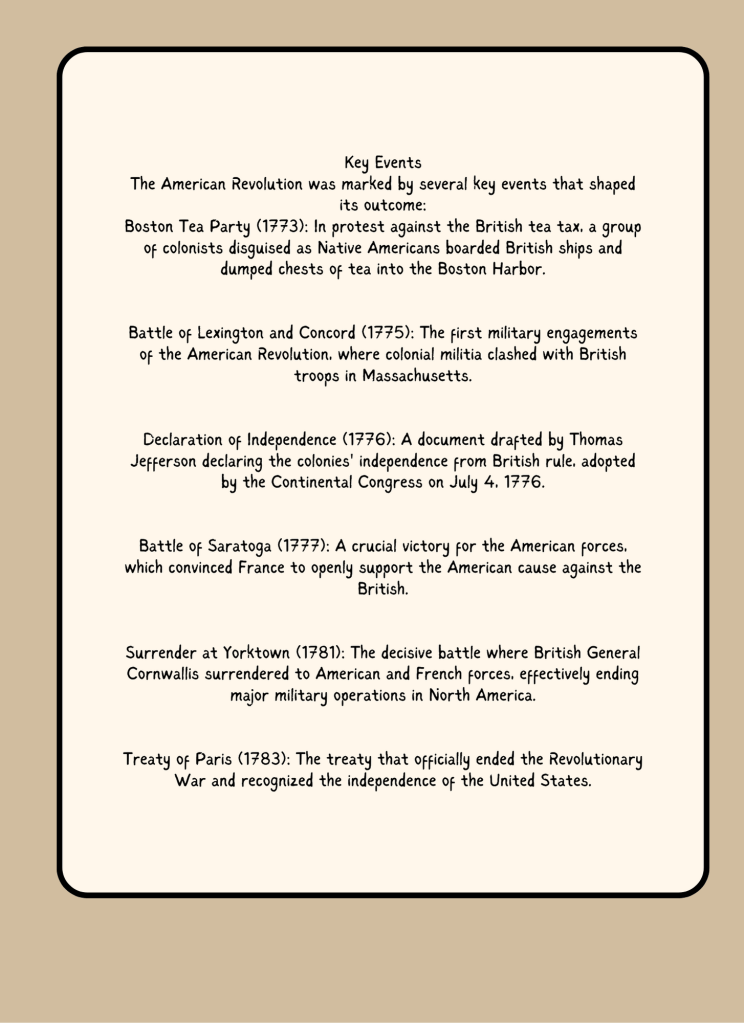
- The Treaty of Paris, signed in 1783, formally ended the Revolutionary War and recognized the independence of the United States from British rule.
The Surrender at Yorktown stands as a pivotal moment in American history, symbolizing the triumph of freedom over tyranny and the birth of a new nation. It was the culmination of years of struggle, sacrifice, and determination by the American colonies in their quest for independence. The legacy of Yorktown lives on as a testament to the courage and resilience of those who fought for liberty and justice, shaping the course of American history for generations to come.
Worksheet: The Surrender at Yorktown, 1781
Instructions:
Read each question carefully. Write your answers in the spaces provided. Have fun learning about the Surrender at Yorktown!
Questions:
What was the Surrender at Yorktown? Describe the event in your own words.
When did the Surrender at Yorktown take place?
Who were the main commanders involved in the Surrender at Yorktown?
Where did the Surrender at Yorktown occur?
What was the significance of the siege of Yorktown in the American Revolutionary War?
Describe the conditions that led to the surrender of the British army at Yorktown.
What role did General George Washington and the French forces play in the Surrender at Yorktown?
What impact did the Surrender at Yorktown have on the outcome of the American Revolutionary War?
Why is the Surrender at Yorktown considered a pivotal moment in American history?
Imagine you are a soldier participating in the Surrender at Yorktown. Write a short journal entry describing your experiences and feelings during the event.
Bonus Question:
Research and list two key figures who played important roles in the Surrender at Yorktown, aside from General George Washington. Write a brief description of each.
Bonus Question:
Research and list one key figure from the Battle of Saratoga who played an important role but is often not as well-known. Write a brief description of their contribution.
Chapter 7-The Treaty of Paris 1783
Vocabulary
emerge– to come forth into view or notice, to become apparent or known, or to rise or come forth.
geopolitical– the study or analysis of the relationship between politics and geography, particularly with regard to the influence of geographic factors on political events, decisions, and outcomes.
culminating (culminate)- the final or ultimate stage of something.
provision- to supply with necessary items or resources, to make arrangements for the future, or to prepare for a particular situation.
delineation– refers to the act of describing or explaining something in detail, often by outlining its specific features, boundaries, or characteristics.
territorial- used to describe anything related to territory, which typically refers to a specific area of land or water that is under the control of a particular government, authority, or group.
reverberate (reverberated)- to echo or resound repeatedly, typically as a result of sound waves reflecting off surfaces.
diplomatic– the art of negotiation, mediation, and relationship-building in both international and interpersonal contexts.
creditors– individuals, businesses, or financial institutions to whom money is owed.
solidify (solidified)- to make or become solid, firm, or stable.
emergence– when something new appears or comes out into the open.
The Treaty of Paris 1783: Sealing the Fate of a New Nation
In the aftermath of the American Revolutionary War, the Treaty of Paris 1783 emerged as a landmark agreement that formally recognized the independence of the United States and reshaped the geopolitical landscape of the world. Let’s delve into this historic treaty and uncover its significance in shaping the destiny of a fledgling nation.
The American Revolutionary War, which began in 1775, saw the American colonies rise up against British rule in a bid for independence. By 1781, the tide of the war had turned decisively in favor of the American forces, culminating in the surrender of the British army at Yorktown. This pivotal moment set the stage for negotiations that would ultimately lead to the Treaty of Paris.
Key Provisions
Signed on September 3, 1783, the Treaty of Paris contained several key provisions that reshaped the geopolitical landscape of North America and beyond:
- Recognition of Independence: The most significant provision of the treaty was the recognition of the United States as an independent nation, free from British rule. This marked the formal end of British colonial dominance in North America and paved the way for the establishment of a new nation.
- Boundaries: The treaty established the boundaries of the United States, extending from the Atlantic Ocean to the Mississippi River in the west, and from Canada in the north to Florida in the south. This delineation set the stage for the expansion of the United States in the years to come.
- Return of Territories: The treaty obligated Britain to return all territories it had captured during the war, including Florida to Spain and various Caribbean islands to France. This restored the pre-war territorial status quo in many regions.
- Recognition of Fishing Rights: The treaty recognized the fishing rights of Americans in certain Canadian waters, ensuring access to valuable fishing grounds.
- Debts and Loyalists: The treaty addressed the issue of debts owed by Americans to British creditors and the treatment of loyalists who had supported the British during the war. It provided for the repayment of debts and recommended that Congress recommend to the states to restore confiscated property to loyalists.
The Treaty of Paris 1783 had far-reaching implications that reverberated across the globe. It secured the independence of the United States and marked the beginning of a new era in American history. The treaty also laid the foundation for peaceful relations between the United States and Britain, setting a precedent for diplomatic cooperation between former adversaries.
Moreover, the Treaty of Paris had significant implications for European powers involved in the war. It weakened Britain’s position in North America and signaled the decline of its colonial empire. Additionally, it contributed to the rise of American influence on the world stage and inspired other nations to seek independence from colonial rule.
In conclusion, the Treaty of Paris 1783 was a watershed moment in history, marking the end of one era and the beginning of another. It solidified the independence of the United States, reshaped the geopolitical landscape of North America, and set the stage for the emergence of a new nation destined for greatness.
Worksheet: THE TREATY OF PARIS 1783
Instructions:
Read each question carefully. Write your answers in the spaces provided. Have fun learning about the Treaty of Paris 1783!
Questions:
What was the Treaty of Paris 1783? Write a brief description in your own words.
When was the Treaty of Paris 1783 signed?
What was the significance of the Treaty of Paris 1783 in relation to the American Revolutionary War?
What was the main provision of the Treaty of Paris 1783 regarding the United States?
Describe the boundaries established for the United States by the Treaty of Paris 1783.
What territories did Britain agree to return as part of the Treaty of Paris 1783?
What rights did the Treaty of Paris 1783 recognize for Americans in certain Canadian waters?
What issue did the Treaty of Paris 1783 address regarding debts owed by Americans to British creditors?
What recommendation did the Treaty of Paris 1783 make regarding confiscated property belonging to loyalists who had supported the British during the war?
Why is the Treaty of Paris 1783 considered a significant event in American history?
Bonus Question:
Research and list one European power involved in the American Revolutionary War and describe their role in negotiating the Treaty of Paris 1783.

 Unleashed Learning Gateway