
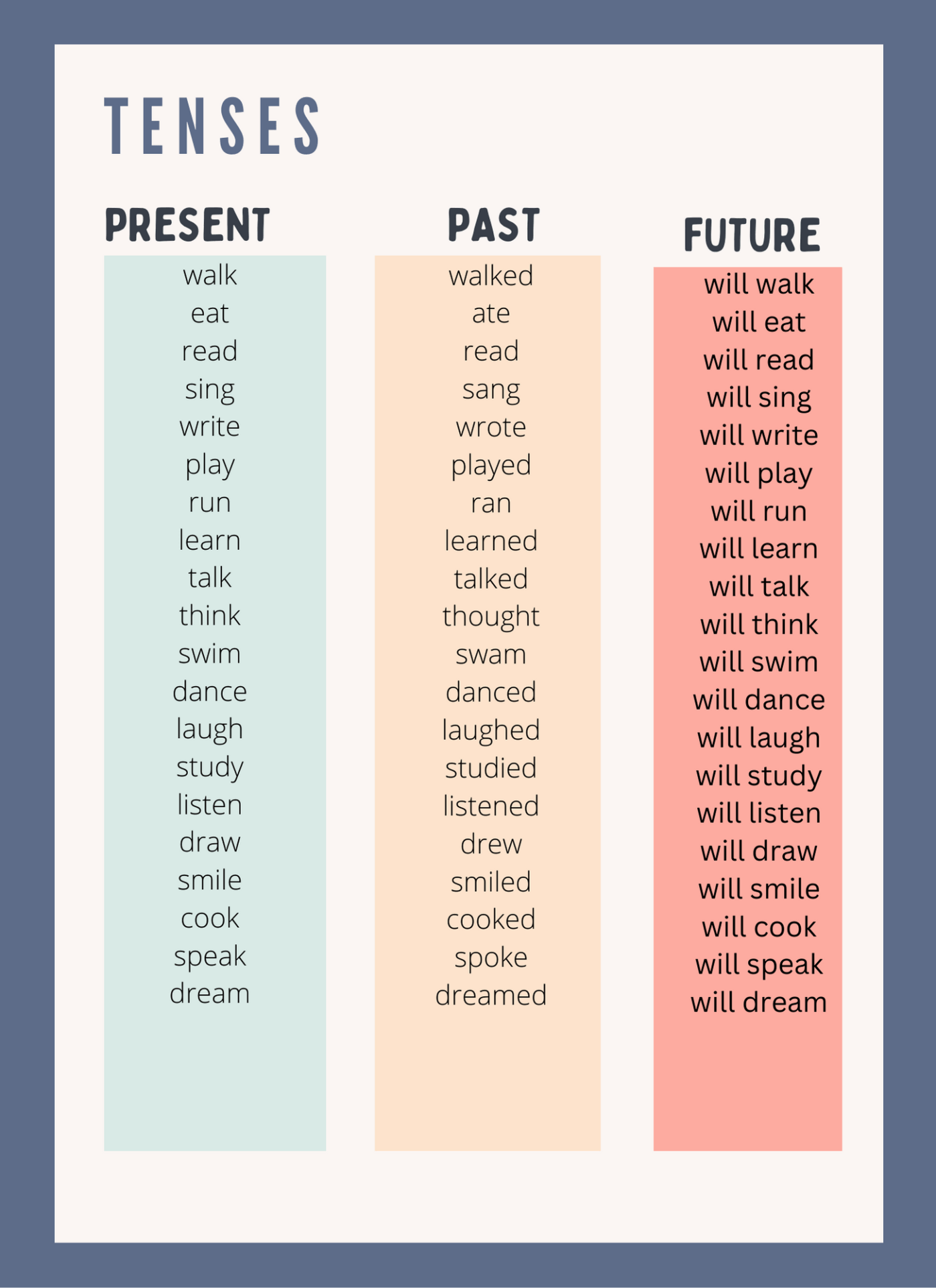
Understanding Verb Tenses: Present, Past, and Future
In the English language, verb tenses play a crucial role in indicating the timing of actions or events. Whether we’re describing something happening now, recounting past occurrences, or predicting future events, verb tenses help us communicate with clarity and precision. Let’s explore the three primary verb tenses: present, past, and future.
Present Tense: The Here and Now
The present tense is used to describe actions or states that are currently happening, habitual actions, or timeless truths. It’s the tense we use to talk about what is occurring at the moment of speaking. For example:
- “She walks to school every day.” (habitual action)
- “The sun rises in the east.” (timeless truth)
- “I am reading a book.” (action currently happening)
In each of these sentences, the verbs “walks,” “rises,” and “am reading” indicate actions or states that are happening in the present moment.
Past Tense: Reflecting on What Has Happened
The past tense is used to describe actions or events that have already occurred, whether recently or in the distant past. It allows us to recount past experiences or describe historical events. For example:
- “She walked to school yesterday.” (action completed in the past)
- “They visited Paris last summer.” (past event)
- “He was reading a book when the phone rang.” (action interrupted in the past)
In these sentences, the verbs “walked,” “visited,” and “was reading” indicate actions that have already taken place.
Future Tense: Anticipating What Is to Come
The future tense is used to express actions or events that will happen at a later time, whether in the near or distant future. It allows us to make predictions, plans, or promises about what is to come. For example:
- “She will walk to school tomorrow.” (future action)
- “We are going to travel around the world next year.” (future plan)
- “I’ll call you when I arrive.” (future action contingent on another event)
In these sentences, the verbs “will walk,” “are going to travel,” and “will call” indicate actions or events that are yet to occur.
Why Verb Tenses Matter
Understanding verb tenses is essential for effective communication. By using the appropriate tense, we can convey information accurately and convey our intended meaning clearly. Verb tenses also help us establish temporal relationships between events, allowing listeners or readers to follow the timeline of a narrative or discussion.
Moreover, verb tenses play a significant role in writing, as they contribute to the overall tone and style of a piece. Whether writing fiction, academic essays, or business reports, choosing the right verb tense can enhance the coherence and readability of the text.
Mastering Verb Tenses
Mastering verb tenses takes practice and attention to detail. It involves understanding the rules governing each tense, recognizing irregular verb forms, and knowing when to use auxiliary verbs or verb phrases to convey nuances of meaning.
One effective way to improve proficiency in verb tenses is through reading and writing extensively. By exposing ourselves to various texts and contexts, we become more familiar with the patterns and conventions of verb usage.
In conclusion, verb tenses are powerful tools that enable us to convey temporal information and communicate effectively. Whether describing the present, recounting the past, or anticipating the future, mastering verb tenses is essential for clear and accurate expression in both spoken and written communication.
Take a look at the examples below:
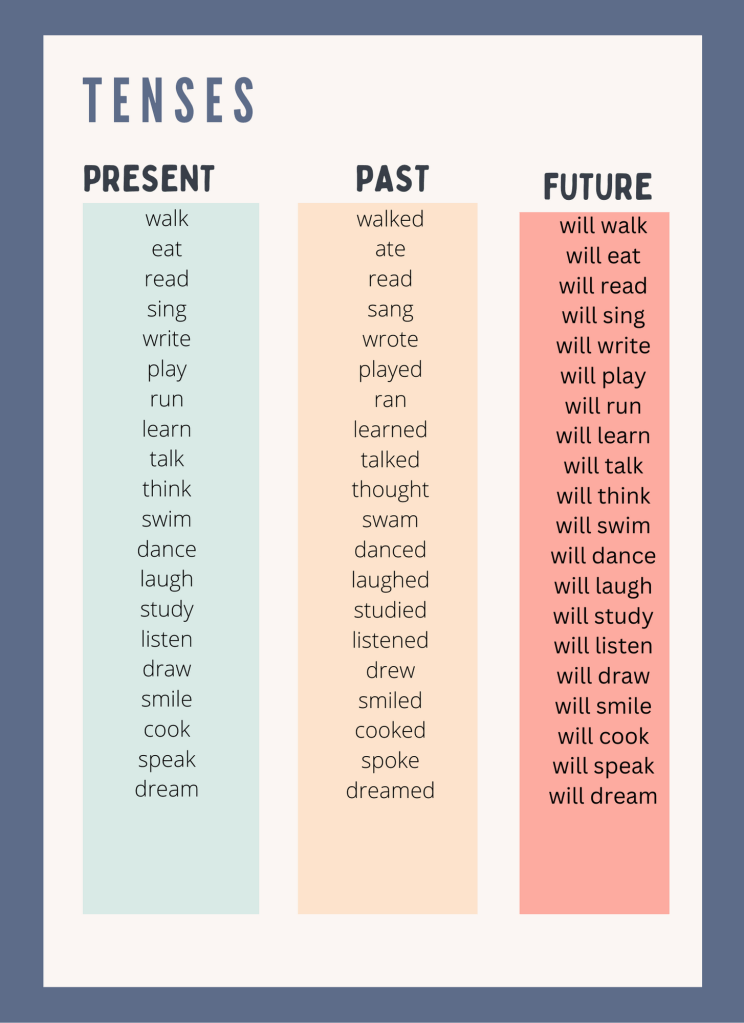
Let’s Practice! Fill in the blank with the correct verb tense.
- She __________ (sing) in the school choir every Friday.
- Yesterday, they __________ (play) basketball at the park.
- By this time next year, we __________ (graduate) from college.
- The cat __________ (sleep) peacefully on the windowsill.
- I __________ (read) an interesting book about space exploration.
- Last summer, she __________ (visit) her grandparents in the countryside.
- Next month, we __________ (travel) to Europe for our vacation.
- The sun __________ (rise) in the east every morning.
- He __________ (write) a letter to his friend last night.
- By the time the guests arrive, we __________ (prepare) dinner.
- They __________ (study) for their exams all week.
- Tomorrow, we __________ (go) to the beach for a picnic.
- The children __________ (build) a sandcastle on the beach yesterday.
- I __________ (watch) a movie with my friends last weekend.
- In a few years, he __________ (become) a famous musician.

 Unleashed Learning Gateway