
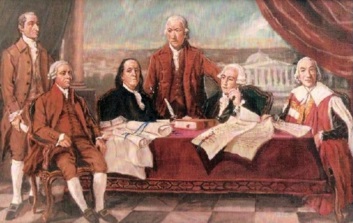
Chapter 7-The Treaty of Paris 1783
Vocabulary
emerge– to come forth into view or notice, to become apparent or known, or to rise or come forth.
geopolitical– the study or analysis of the relationship between politics and geography, particularly with regard to the influence of geographic factors on political events, decisions, and outcomes.
culminating (culminate)- the final or ultimate stage of something.
provision- to supply with necessary items or resources, to make arrangements for the future, or to prepare for a particular situation.
delineation– refers to the act of describing or explaining something in detail, often by outlining its specific features, boundaries, or characteristics.
territorial- used to describe anything related to territory, which typically refers to a specific area of land or water that is under the control of a particular government, authority, or group.
reverberate (reverberated)- to echo or resound repeatedly, typically as a result of sound waves reflecting off surfaces.
diplomatic– the art of negotiation, mediation, and relationship-building in both international and interpersonal contexts.
creditors– individuals, businesses, or financial institutions to whom money is owed.
solidify (solidified)- to make or become solid, firm, or stable.
emergence– when something new appears or comes out into the open.
The Treaty of Paris 1783: Sealing the Fate of a New Nation
In the aftermath of the American Revolutionary War, the Treaty of Paris 1783 emerged as a landmark agreement that formally recognized the independence of the United States and reshaped the geopolitical landscape of the world. Let’s delve into this historic treaty and uncover its significance in shaping the destiny of a fledgling nation.
The American Revolutionary War, which began in 1775, saw the American colonies rise up against British rule in a bid for independence. By 1781, the tide of the war had turned decisively in favor of the American forces, culminating in the surrender of the British army at Yorktown. This pivotal moment set the stage for negotiations that would ultimately lead to the Treaty of Paris.
Key Provisions
Signed on September 3, 1783, the Treaty of Paris contained several key provisions that reshaped the geopolitical landscape of North America and beyond:
- Recognition of Independence: The most significant provision of the treaty was the recognition of the United States as an independent nation, free from British rule. This marked the formal end of British colonial dominance in North America and paved the way for the establishment of a new nation.
- Boundaries: The treaty established the boundaries of the United States, extending from the Atlantic Ocean to the Mississippi River in the west, and from Canada in the north to Florida in the south. This delineation set the stage for the expansion of the United States in the years to come.
- Return of Territories: The treaty obligated Britain to return all territories it had captured during the war, including Florida to Spain and various Caribbean islands to France. This restored the pre-war territorial status quo in many regions.
- Recognition of Fishing Rights: The treaty recognized the fishing rights of Americans in certain Canadian waters, ensuring access to valuable fishing grounds.
- Debts and Loyalists: The treaty addressed the issue of debts owed by Americans to British creditors and the treatment of loyalists who had supported the British during the war. It provided for the repayment of debts and recommended that Congress recommend to the states to restore confiscated property to loyalists.
The Treaty of Paris 1783 had far-reaching implications that reverberated across the globe. It secured the independence of the United States and marked the beginning of a new era in American history. The treaty also laid the foundation for peaceful relations between the United States and Britain, setting a precedent for diplomatic cooperation between former adversaries.
Moreover, the Treaty of Paris had significant implications for European powers involved in the war. It weakened Britain’s position in North America and signaled the decline of its colonial empire. Additionally, it contributed to the rise of American influence on the world stage and inspired other nations to seek independence from colonial rule.
In conclusion, the Treaty of Paris 1783 was a watershed moment in history, marking the end of one era and the beginning of another. It solidified the independence of the United States, reshaped the geopolitical landscape of North America, and set the stage for the emergence of a new nation destined for greatness.
Worksheet: THE TREATY OF PARIS 1783
Instructions:
Read each question carefully. Write your answers in the spaces provided. Have fun learning about the Treaty of Paris 1783!
Questions:
What was the Treaty of Paris 1783? Write a brief description in your own words.
When was the Treaty of Paris 1783 signed?
What was the significance of the Treaty of Paris 1783 in relation to the American Revolutionary War?
What was the main provision of the Treaty of Paris 1783 regarding the United States?
Describe the boundaries established for the United States by the Treaty of Paris 1783.
What territories did Britain agree to return as part of the Treaty of Paris 1783?
What rights did the Treaty of Paris 1783 recognize for Americans in certain Canadian waters?
What issue did the Treaty of Paris 1783 address regarding debts owed by Americans to British creditors?
What recommendation did the Treaty of Paris 1783 make regarding confiscated property belonging to loyalists who had supported the British during the war?
Why is the Treaty of Paris 1783 considered a significant event in American history?
Bonus Question:
Research and list one European power involved in the American Revolutionary War and describe their role in negotiating the Treaty of Paris 1783.

 Unleashed Learning Gateway