
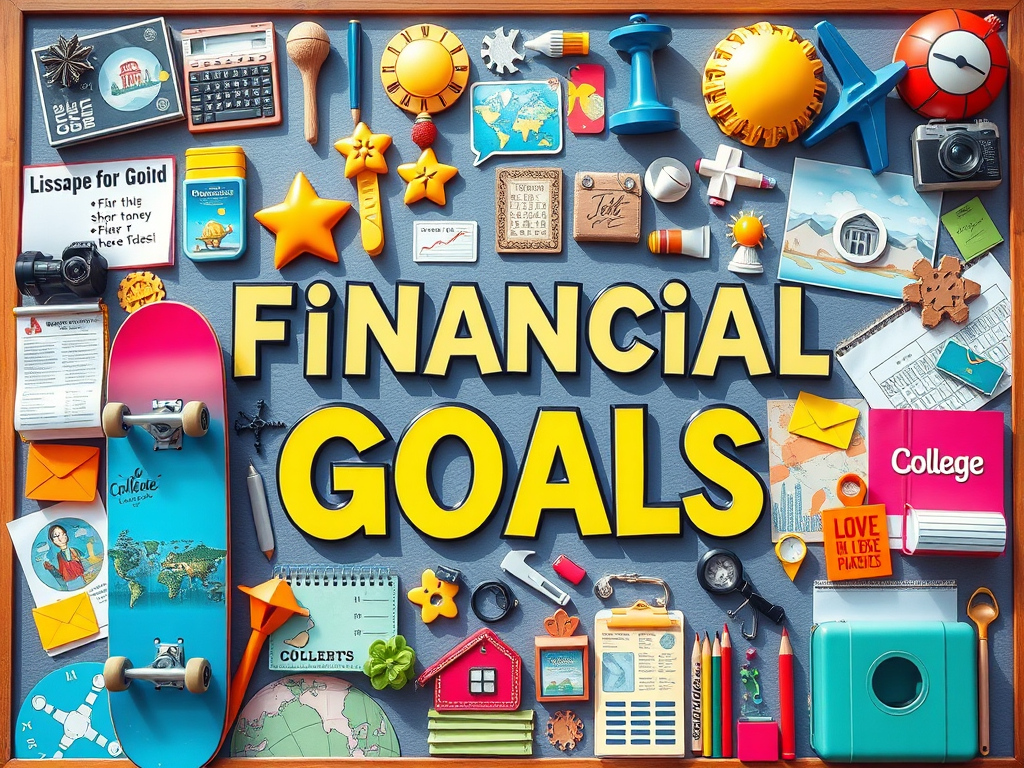
Journal Topic:
👉 “What are some things you want to save money for in the future?”
Take a few minutes to reflect and write your thoughts. Think about things both big and small — a new game, college, a car, a trip, or even starting a business someday.
What Are Financial Goals and Why Do They Matter?
Financial goals are plans you make for how you want to use and save your money. Just like setting goals for school, sports, or hobbies, money goals help you focus, plan ahead, and stay motivated.
They Matter because:
- They help you make smart decisions about spending.
- They give you a clear direction for your future.
- They teach you responsibility and independence.
Whether it’s saving up for something fun or preparing for the future, setting financial goals is an important life skill.
Short-Term vs. Long-Term Goals
Financial goals can be grouped into two main categories:
- Short-Term Goals:
These can be achieved fairly quickly — usually within a few weeks or months.
Examples:- Saving for a new skateboard
- Buying a new outfit
- Getting tickets to a concert
- Saving for a video game
- Long-Term Goals:
These take more time — often a year or more — and usually involve bigger plans or larger amounts of money.
Examples:- Saving for college
- Buying a car
- Traveling abroad
- Starting a business
Example: Ana’s Skateboard Goal
Ana loves skateboarding. She already has one, but she dreams of getting a new skateboard with all the latest designs. The skateboard she wants costs $45.
Her parents say that if she really wants it, she’ll have to save up the money herself.
Ana receives $20 per week for doing chores like cleaning her room, the bathroom, and washing dishes. At the end of the month, if she earns all A’s and B’s, she also receives a $10 bonus.
Let’s figure out:
- In two weeks, Ana saves $40.
- In three weeks, she saves $60.
💡 So Ana will have enough money in about 3 weeks to buy the skateboard.
This is considered a short-term goal because she can reach it in less than a month.
Class Discussion
Think about your own future dreams.
- What’s something short-term you could start saving for?
- What’s something long-term that you’d love to work toward?
How does money play a role in reaching those dreams?
Activity: Create Your Vision Board
🎨 Let’s get creative!
Make a Vision Board that shows your financial dreams and goals.
Give your board a fun name — for example, “My Future Goals.”
You can use:
- ✍️ Drawings
- 📰 Magazine cutouts
- 💻 Digital tools (e.g., Canva, Google Slides, Jamboard)
Include at least one short-term and one long-term goal.
When you’re done, you can choose to share your vision board with the class.
📝 Tip: Play calm background music while you work to set a creative mood.
Optional Materials Needed
- Poster paper or cardstock
- Magazines, scissors, glue, markers
- Optional: computers or tablets for digital boards
Key Terms
- Goals — something you want to achieve
- Short-term — goals you can reach soon (weeks or months)
- Long-term — goals that take more time (a year or more)
Knowledge Check – Multiple Choice Questions
- What is a financial goal?
a) A dream you can’t achieve
b) A plan for how to save and use your money
c) A type of bank account
d) A wish for free money
- Which of the following is a short-term goal?
a) Buying a house
b) Saving for college
c) Buying a new skateboard next month
d) Traveling abroad in five years
- How long do long-term goals usually take?
a) A few days
b) A week
c) A year or more
d) One hour
- Why are financial goals important?
a) They help you spend money faster
b) They give you direction and teach responsibility
c) They make chores easier
d) They replace good grades
- Ana’s skateboard goal is an example of:
a) A long-term goal
b) A short-term goal
c) A wish
d) A group project
Answers
1.✅ Answer: b
2.✅ Answer: c
3.✅ Answer: c
4.✅ Answer: b
5.✅ Answer: b
 Unleashed Learning Gateway