
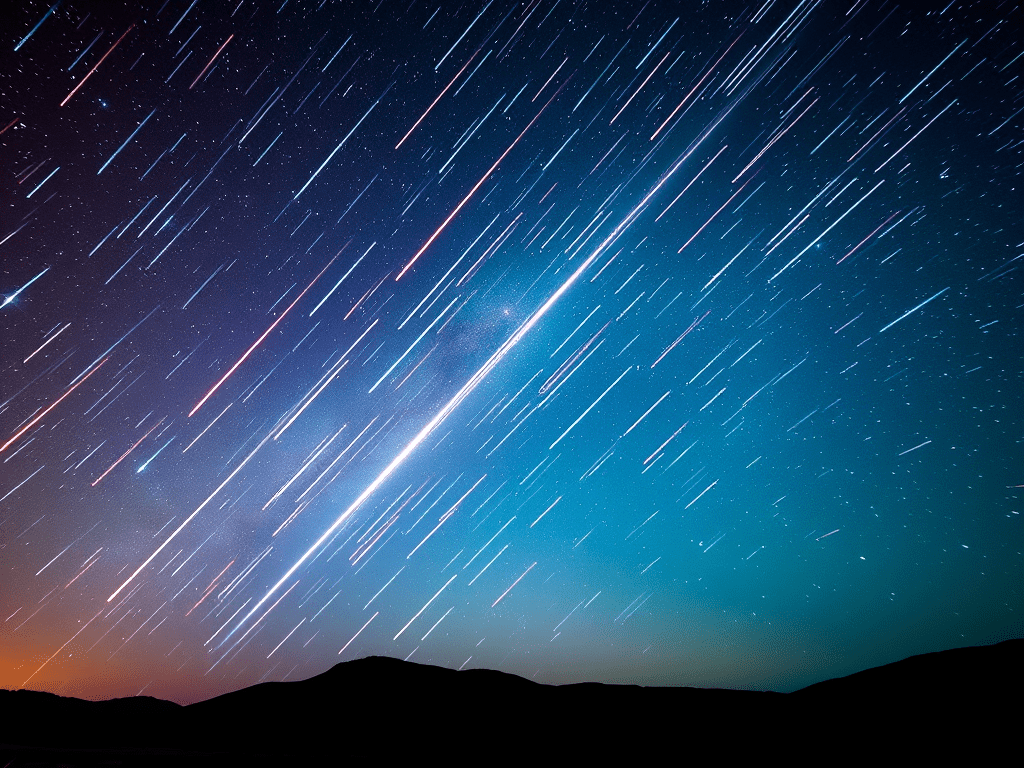

Have you ever looked up at the night sky and seen a bright streak of light glide across it for just a moment? Many people call that a “shooting star.” But as you’ll discover in this essay, what you saw wasn’t actually a star at all. It was a piece of space rock or dust burning up in Earth’s atmosphere — what scientists call a meteor. The study of meteors involves interesting physics, astronomy, and Earth-science. In this essay, we’ll dig into what causes those streaks of light, why they burn up, how meteor showers work, and how you can observe them or even do a simple hands-on activity at home.
We’ll also include a pronunciation key for tricky scientific words, links for videos, further reading articles, a vocabulary list, some quiz questions, and a fun experiment you can try. Let’s blast off!
What is a “shooting star”?
The terminology
First, let’s sort out the terms.
- meteoroid (meh-TEE-uh-roid): A small piece of rock or dust in space, before it hits Earth’s atmosphere.
- meteor (MEE-tee-or): The streak of light we see when a meteoroid enters Earth’s atmosphere and burns up.
- meteorite (MEE-tee-uh-rite): Any fragment of a meteoroid that survives the trip through the atmosphere and lands on Earth.
So when you see a “shooting star,” you’re actually watching a meteor — a meteoroid burning up in the atmosphere.
For more details, the NASA Science page is a great read. NASA Science+1
Why does it light up?
Here’s the physics in action: A meteoroid enters Earth’s atmosphere at extremely high speed (tens of thousands of kilometers per hour). Because it’s moving so fast, the air in front of it is suddenly compressed, heated, and interacts with the meteoroid. The friction (and more precisely the compression and heating of air) causes the meteoroid to heat up and vaporize (or “ablate”), which produces the glowing streak you see as a meteor.
As one NASA explanation puts it: “When meteoroids enter Earth’s atmosphere … at high speed and burn up, the fireballs or ‘shooting stars’ are called meteors.”
How meteor showers happen
Streams of debris
Some nights you might see one or two meteors. But other times you might see dozens — that’s when Earth passes through a meteor shower. These occur when Earth goes through the trail of debris left behind by a comet or, less often, an asteroid.
The particles in that trail are many tiny meteoroids. As Earth moves through the debris stream, they enter the atmosphere and burn up, creating lots of meteors in a short time. That’s what a meteor shower is.
Radiant point and naming
Meteor showers are named after the constellation from which they appear to come (though they don’t actually come from that constellation!). The “radiant” is the point in the sky from which the meteors seem to radiate.
Example: The Perseid meteor shower
The Perseids, one of the most famous meteor showers, are caused by debris from Swift–Tuttle. They are active in mid-July through late August and peak around August 12–13, offering many meteors per hour under dark sky conditions.
The journey of a meteoroid into a meteor
Let’s walk step-by-step through what happens:
- A meteoroid (rock or dust in space) orbits the Sun, or is part of a comet’s debris field.
- As Earth moves along its orbit, sometimes it intersects the path of these meteoroids.
- When the meteoroid enters Earth’s atmosphere, it experiences rapid heating due to high velocity and friction/air-compression.
- The surface of the meteoroid begins to vaporize; it glows and creates a bright streak: a meteor.
- Most meteoroids are small and burn up entirely high in the atmosphere — so you just see the light and nothing reaches the ground.
- If a meteoroid is large and dense enough, a part of it may survive and land on Earth as a meteorite.
Some deeper science for high-schoolers
Speeds and altitudes
Meteoroids can enter Earth’s atmosphere at speeds like 11 km/s (minimum escape velocity from Earth) and often much higher, up to tens of kilometers per second. They usually burn up in the mesosphere (altitudes around 70–100 km).
Ionization and trails
As the meteoroid travels through the atmosphere it ionizes the surrounding air: electrons are stripped from atoms, creating a glowing trail of ionized gas. Some meteor trails persist for seconds or minutes due to these ionization trails.
Fact: Tons of meteoritic material
It’s estimated that about 44,000 kilograms (≈ 48.5 tons) of meteoritic material falls on Earth each day — though almost all of it is very small particles and burns up in the atmosphere.
Variations: Fireballs and bolides
When a meteoroid is larger and brighter than usual, it may appear as a fireball (very bright meteor) or even a bolide (an extremely bright explosion in the sky).
Why we care – significance
- Scientific research: Studying meteors and meteorites gives us clues about the composition of comets, asteroids, and the early solar system.
- Public engagement & astronomy: Meteor showers are accessible — you don’t need a telescope to enjoy them.
- Planetary defense: Understanding how objects enter the atmosphere helps design ways to track or mitigate larger asteroids.
- Natural phenomena: Meteors are thrilling to watch and connect us to the vastness of space in a direct way.
Resources for further reading & videos
Here are two excellent articles to read (outside this essay) plus a video link.
Articles
- “Meteors and Meteorites — Facts” from NASA Science. NASA Science
[Link: https://science.nasa.gov/solar-system/meteors-meteorites/facts/] - “What is a shooting star?” from Cool Cosmos (Caltech). Cool Cosmos
[Link: https://coolcosmos.ipac.caltech.edu/ask/255-what-is-a-shooting-star-]
Video
Pronunciation key
Here are some tricky scientific words with pronunciation guides and an external pronounce link (via Google). Copy and Paste the links into your browser.
- meteoroid — (meh-TEE-uh-roid) [help: https://www.google.com/search?q=pronounce+meteoroid ]
- meteor — (MEE-tee-or) [help: https://www.google.com/search?q=pronounce+meteor ]
- meteorite — (MEE-tee-uh-rite) [help: https://www.google.com/search?q=pronounce+meteorite ]
- ablation — (uh-BLAY-shun) [help: https://www.google.com/search?q=pronounce+ablation ]
- ionization — (eye-oh-nuh-ZAY-shun) [help: https://www.google.com/search?q=pronounce+ionization ]
- mesosphere — (MEE-zuh-sfeer) [help: https://www.google.com/search?q=pronounce+mesosphere ]
- bolide — (BOH-lyde) [help: https://www.google.com/search?q=pronounce+bolide ]
- radiant (in this meteor-context) — (RAY-dee-uhnt) [help: https://www.google.com/search?q=pronounce+radiant ]
Hands-On Activity: “Simulate a Meteor Burn” (Adult Supervision Required)
Cost: Very low (items you can find around the house)
Purpose: To help you visualize how a meteoroid entering the atmosphere can heat up and burn.
Materials:
- A small rock or pebble (washed clean) or a piece of chalk (as substitute)
- A heat-source safe under adult supervision (for example: a candle or small lamp)
- A pair of metal tweezers or tongs
- A flashlight or lamp in a dim room
- Fire-safe plate or tray
- Safety goggles and adult supervision.
Procedure:
- In a dim room, turn off most lights and have a flashlight ready.
- Place the rock or chalk piece on the fire-safe plate.
- Use the tweezers to hold the rock or chalk about 2–3 cm above the candle flame (with adult supervision) or use a lamp that emits heat above it (if actual flame is too risky).
- Observe what happens to the rock/chalk: Does the surface darken? Does it glow slightly?
- After a short time (30–60 seconds) remove the rock, place it under the flashlight and look for changes (surface color, texture).
- In the dim room, shine the flashlight from the side to cast a shadow and observe any glow or residue from the heating.
- Record your observations in the chart below.
Student Chart to Fill Out:
Directions: Take a piece of notebook paper or etc and create the chart below.
| Trial # | Material used | Time heated | What did you observe during heating? (color change, glow, surface texture) | What did you observe after heating under flashlight? | What do you think happened and why? |
|---|---|---|---|---|---|
| 1 | |||||
| 2 | |||||
| 3 |
Questions about the activity:
- What changes did you observe in the material during heating?
- How do these changes help you understand what happens to a meteoroid entering Earth’s atmosphere?
- Why is the ability to burn up (or ablate) important for meteoroids—what happens if a meteoroid doesn’t burn up?
- What limitations are there in this simulation compared to a real meteoroid entering Earth’s atmosphere?
- If you repeated this experiment but used a larger piece of rock, what might you expect to observe and why?
Vocabulary Search (find-and-define)
Here are eight keywords. Use a dictionary or your own learning to define each in your own words:
- Meteoroid
- Meteor
- Meteorite
- Ablation
- Ionization
- Radiant (in meteor-shower context)
- Fireball
- Trajectory
Multiple-Choice Questions
Choose the best answer for each.
- What is a meteor (commonly called a “shooting star”)?
A) A star moving fast across the sky
B) A piece of space rock that lands on Earth
C) The light trail created when a meteoroid burns up in our atmosphere
D) A comet tail visible at night - A meteoroid becomes a meteor when:
A) It leaves Earth’s surface
B) It enters Earth’s atmosphere and burns up
C) It lands on Earth as a rock
D) It passes near the Moon - Most meteoroids that hit Earth’s atmosphere:
A) Land intact on the ground
B) Burn up completely before reaching the surface
C) Turn into comets
D) Become permanent satellites - A meteor shower occurs when:
A) Many meteoroids land on Earth at the same time
B) Earth passes through a stream of debris left by a comet or asteroid
C) A single huge meteoroid breaks into pieces
D) The Sun emits particles toward Earth - Which of the following describes a “fireball” in meteor-terms?
A) A meteor brighter than any planet in the sky
B) A meteor that lands on Earth
C) A comet tail
D) A piece of space junk
Critical Thinking Question
Imagine you are an astronomer on a mission to design a system that detects larger meteoroids before they enter Earth’s atmosphere (so we can track potential meteorite fall). Based on what you’ve learned about meteoroids and meteors, list at least three challenges you would face in building such a detection system — and propose how you might try to overcome them.
Final Thoughts!
Next time you see a “shooting star,” remember: it’s not a star at all, but a tiny piece of space rock zipping through Earth’s atmosphere and burning up. Understanding that simple but profound fact opens a window into space, physics, and our planet’s connection to the solar system. Use the hands-on activity, watch the video, read the articles, and take time to look up at the sky — you might just catch a meteor in the act.
Happy stargazing!
Parents must sign in to view Answers.
 Unleashed Learning Gateway