
Objective
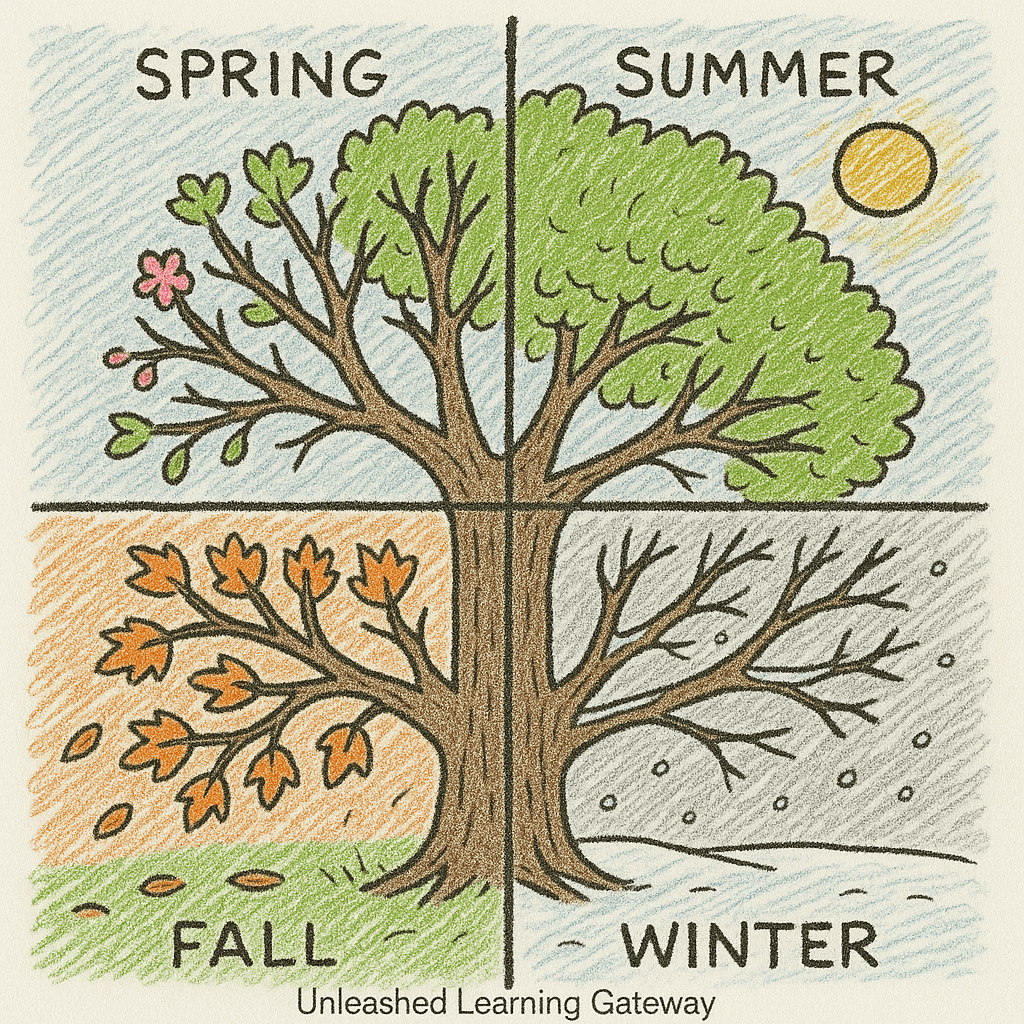
Students will illustrate and label how trees change through the four seasons — spring, summer, fall, and winter — to understand how plants adapt to seasonal patterns in nature.
Materials Needed
- White drawing paper or poster board
- Colored pencils, crayons, or markers
- Pencil and eraser
- Ruler (optional)
- Labels or sticky notes (optional)
Directions
- Divide Your Paper
- Fold your paper into four sections or draw four equal boxes.
- Label each section with a season: Spring, Summer, Fall, Winter.
- Draw the Tree of Seasons
- In each section, draw the same tree — but show how it looks in that season.
- 🌸 Spring: buds, blossoms, and new leaves.
- 🌞 Summer: full green leaves and bright sunlight.
- 🍁 Fall: colorful leaves turning orange, red, and yellow.
- ❄️ Winter: bare branches, maybe snow or frost.
- In each section, draw the same tree — but show how it looks in that season.
- Add Seasonal Details
- Include changes in weather, animals, or surroundings (birds, snowflakes, sunlight, etc.).
- You can also show the sky color changing with each season.
- Label Your Drawing
- Write short notes explaining what happens to the tree and environment in each season (e.g., “Leaves fall to prepare for winter rest”).
- Use arrows or lines to point to key details.
- Title and Decorate
- Give your artwork a creative title like “The Life of a Tree Through the Seasons.”
- Add your name and date.
Reflection Questions
- What changes did you notice about the tree from one season to the next?
- Why do trees lose their leaves in fall and winter?
- How does weather affect plant life during each season?
- Which season do you think is most important for a tree’s life cycle — and why?
Extension Idea
Turn this activity into a mini exhibit! Hang all the drawings side-by-side in order of the seasons to create a “Gallery of Changing Trees.” Students can walk through and observe how each tree tells its own story of change and growth.
 Unleashed Learning Gateway