

What Is Leaf Chromatography?
Chromatography is a scientific method used to separate mixtures into their individual components. In plants, this process helps us see that a single green leaf actually contains several different pigments—not just chlorophyll.
These pigments each have different roles:
- Chlorophyll (green) helps capture light for photosynthesis.
- Carotenoids (orange) and xanthophylls (yellow) protect the plant and help absorb extra light energy.
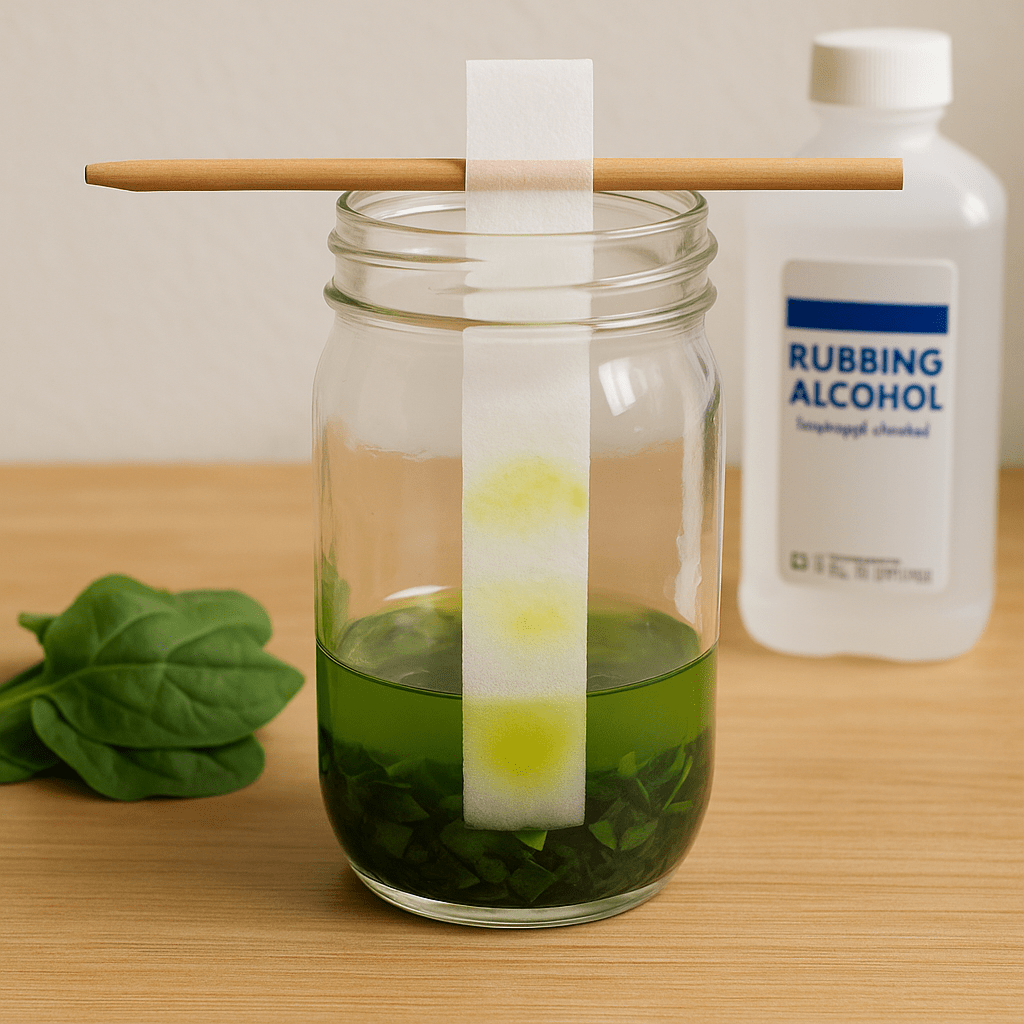
During chromatography, pigments dissolve in a solvent (like rubbing alcohol) and move up paper or a coffee filter at different speeds. The result is a series of colored bands that reveal the hidden pigments in the leaf.
🌿 Experiment: Separating Leaf Pigments
Objective
To observe and separate the different pigments found in green leaves using paper chromatography.
Materials
- Fresh green leaves (spinach, ivy, or another leafy plant)
- Scissors
- Rubbing alcohol (isopropyl alcohol)
- Small glass or jar
- Coffee filter (cut into a strip)
- Spoon or popsicle stick
- Tape
- Pencil or straw
- Plastic wrap
Procedure
- Prepare the Leaf Sample
- Cut or tear leaves into small pieces.
- Place the pieces in the bottom of the jar (about halfway full).
- Add Alcohol
- Pour in enough rubbing alcohol to just cover the leaf bits.
- Extract the Pigments
- Use the spoon or stick to mash the leaves, helping the pigments dissolve.
- Cover the jar with plastic wrap and set it in a warm place (like near a sunny window or lamp) for 30–45 minutes, until the alcohol turns green.
- Prepare the Chromatography Strip
- Cut a strip of coffee filter long enough to reach the alcohol but not touch the bottom of the jar.
- Tape the strip to a pencil or straw and rest it across the top of the jar.
- Run the Chromatography
- Let the end of the filter strip just touch the green alcohol solution.
- Leave it for 30–60 minutes, until you see different colors move up the paper.
- Observe the Results
- Remove the strip and let it dry.
- Look for bands of green, yellow, or orange pigments — these show the different molecules that make up the leaf’s color.
Analysis Questions
- What colors do you see on your chromatography strip?
- Which pigment traveled the farthest? Why do you think that is?
- What does this experiment reveal about leaves and photosynthesis?
- How might pigment patterns differ in leaves from different plants or during fall?
 Unleashed Learning Gateway