
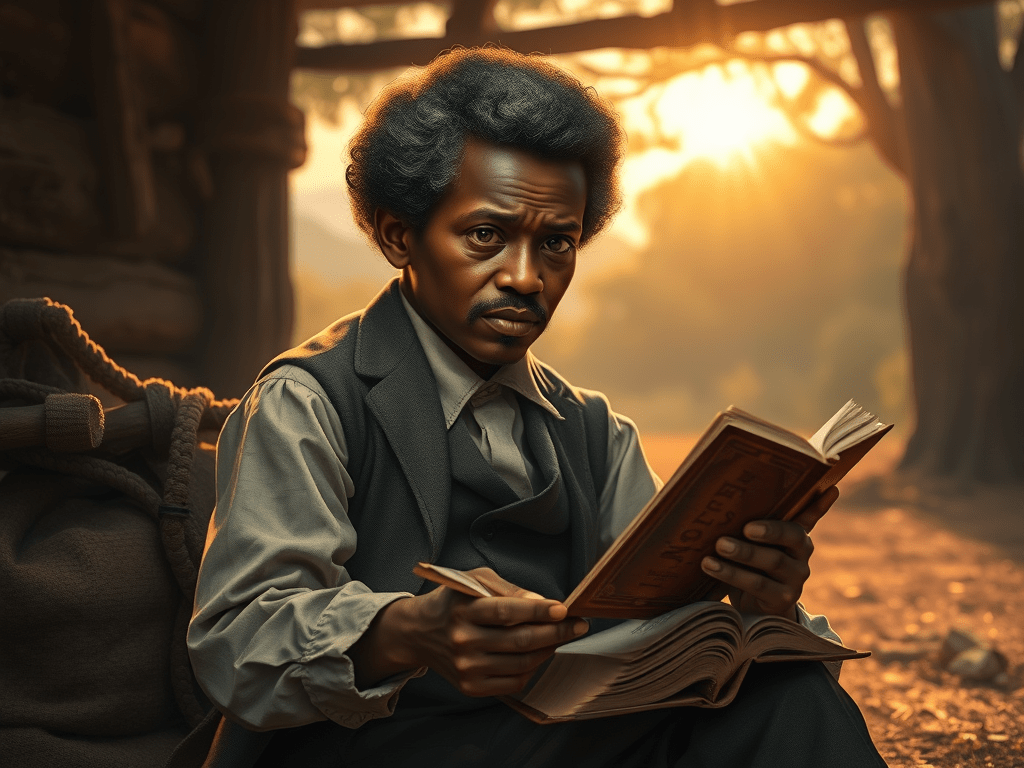
When Frederick Douglass was a little boy, his life didn’t look anything like the lives many of us know today.
He was born in February 1818 in Talbot County, Maryland, into slavery. His mother, Harriet Bailey, was enslaved, and his father was unknown, though believed to be a white man. Because slavery was meant to strip people of family, safety, and choice, Frederick was separated from his mother at a very young age. He grew up without the stability and protection many of us depend on.
Even worse, Frederick wasn’t allowed to go to school.
In fact, enslaved people were forbidden to learn to read or write. The people who enslaved him believed that if he stayed uneducated, he would stay powerless.
But Frederick had something stronger than fear.
He had curiosity.
📚 When Learning Becomes an Act of Courage
Frederick noticed that whenever he tried to learn letters or words, adults reacted with anger. That’s when he realized something important:
👉 If they didn’t want him to learn… learning must be powerful.
So he secretly taught himself. He asked neighborhood children questions. He practiced writing on scraps. He studied signs, books, and newspapers whenever he could.
Many of us can relate to struggling in school, feeling behind in reading, being told we “can’t,” or feeling embarrassed to ask for help.
Frederick felt that too.
But instead of quitting, he kept going. And the more he learned, the more he began to understand something life-changing:
✨ He deserved to be free.
🏃🏽♂️ From Enslaved Child to Free Man
In 1838, Frederick Douglass did something incredibly brave.
He escaped slavery.
He made his way to the North, where he could finally live as a free man. But he didn’t stop there. Frederick could have lived quietly. Instead, he chose to speak.
And when he spoke, people listened.
He became one of the most powerful abolitionists of his time — someone who fought to end slavery. He traveled the country giving speeches. He wrote bestselling books about his life. He challenged leaders. He pushed America to face the truth.
Frederick Douglass turned his pain into purpose.
🗣️ Why His Voice Was So Important
At a time when many people believed enslaved people had nothing intelligent to say, Frederick Douglass stood before crowds and proved them wrong.
He showed the world that:
• Enslaved people were thinkers
• Education is power
• Stories can change hearts
• Words can challenge systems
He didn’t just fight for himself. He fought for millions.
🌱 Why Frederick Douglass Still Matters Today
Frederick Douglass’s story isn’t just history. It’s relatable.
Many of us face struggles like:
• Feeling unseen
• Being told we aren’t good enough
• Struggling with confidence or learning
• Dealing with unfair rules
• Wanting our voices to matter
Frederick’s life shows us that our starting place does not decide our ending.
His journey reminds us that:
✔ Our voices matter
✔ Learning gives us power
✔ Our stories have value
✔ We can grow beyond what hurts us
✔ We can use what we’ve been through to help others
✨ A Lesson to Carry Forward
Frederick Douglass once said:
“Once you learn to read, you will be forever free.”
That message still stands.
Every book we open, every question we ask, every skill we build — these are tools. And tools build futures.
Frederick Douglass – Critical Thinking Questions
- Why was learning to read and write considered dangerous for enslaved people?
A. It made enslaved people want different jobs
B. It allowed enslaved people to communicate secretly
C. It gave enslaved people power to think, question, and resist
D. It distracted them from their daily work
- What does Frederick Douglass’s decision to secretly learn to read show about his character?
A. He was reckless and disobedient
B. He was naturally gifted and lucky
C. He was curious, brave, and determined
D. He wanted attention from others
- How did Frederick Douglass use his personal story after escaping slavery?
A. To become famous and wealthy
B. To entertain large audiences
C. To expose the truth about slavery and push for change
D. To distance himself from the past
- Which theme best connects Frederick Douglass’s life to challenges many of us still face today?
A. The importance of competition
B. The power of education and self-belief
C. The need for strict rules
D. The value of silence
- Why was Frederick Douglass’s speaking and writing especially powerful during his time?
A. Many people had never heard an enslaved person’s real experiences before
B. He was the only person who could read
C. He worked for the government
D. He avoided emotional topics
- What is one reason Frederick Douglass is still relevant today?
A. His books are required everywhere
B. His life shows how words and knowledge can challenge injustice
C. He lived longer than most people of his time
D. He traveled to many countries
- Which statement best reflects a lesson we can take from Frederick Douglass’s life?
A. Only leaders can make change
B. Freedom happens by accident
C. Our circumstances define our limits
D. Growth often begins with courage and learning
- If Frederick Douglass were alive today, which action would most likely match his mission?
A. Posting entertainment videos only
B. Avoiding difficult conversations
C. Using platforms to educate, speak out, and empower others
D. Keeping his experiences private
✅ Answer Key
- C
- C
- C
- B
- A
- B
- D
- C
🎯 Activity: “From His Story to Our Story” – The Frederick Douglass Challenge
📌 Purpose
This activity helps learners connect Frederick Douglass’s life to their own experiences, build critical-thinking skills, and understand how learning, voice, and resilience can create change.
🔍 Part 1: Think & Reflect
After reading the article, have learners respond to the prompts below (written, discussion, or small-group style):
• What was one obstacle Frederick Douglass faced that stood out to you most? Why?
• Why do you think learning became such a powerful tool for him?
• What is one challenge people still face today that connects to his story?
✍🏽 Part 2: “If I Were Frederick Douglass Today…”
Learners choose one role and complete it:
Option A – Voice of Change
Write a short speech, poem, or paragraph as if you were Frederick Douglass living today.
Include:
- A problem you see in the world
- Why it matters
- What people should do about it
Option B – Letters of Strength
Write a letter from Frederick Douglass to someone today who is struggling with learning, confidence, or feeling unheard.
Include:
- Encouragement
- A lesson from his life
- A message about education and voice
Option C – Power Poster
Create a poster (paper or digital) titled:
“Learning Is Power.”
It must include:
- One fact about Frederick Douglass
- One quote or original statement inspired by him
- One modern connection
- Images, drawings, or symbols
🎨 Part 3: Creative Expression (Choose One)
• Design a book cover for Frederick Douglass’s life today
• Create a mini-comic of one moment from his childhood and one from today
• Write a short spoken-word piece called “Once I Learned…”
🌱 Closing Discussion
Use one or more:
• How did Frederick Douglass turn struggle into strength?
• What does his story teach us about our own potential?
• How can learning be used today to create change?
 Unleashed Learning Gateway